
Eleven Years of Being Wrong Most of the Time
The Unbearable Lightness of Being Curious

Eleven years ago today, sitting on a rocky beach in Jamaica, I started a project to understand the nature of political power. At the time, I had no idea that I was starting a project, let alone one that would be so grandiose or continue for so long. On that day, I just had an intriguing thought.
I started daydreaming about the small nation of Jamaica and its relationship to a large country like the United States. What if the U.S. decided to attack Jamaica? The U.S could devastate the island at very little cost to itself. (Sorry, Jamaica, for even entertaining this thought.) And if Jamaica attacked the U.S., it would cost a lot but have minimal impact. Conversely, if the two nations decided to trade with each other, they would both prosper, but the impact to the U.S economy would be negligible, whereas it could be significant to Jamaica’s.
These are the kind of thoughts that might occur to a child, but somehow they fascinated me. I drew the two countries as circles in my Moleskin notebook: a large circle for the U.S., a small one for Jamaica. Then I wondered how the changes that I just described could be represented mathematically. I started scribbling equations:
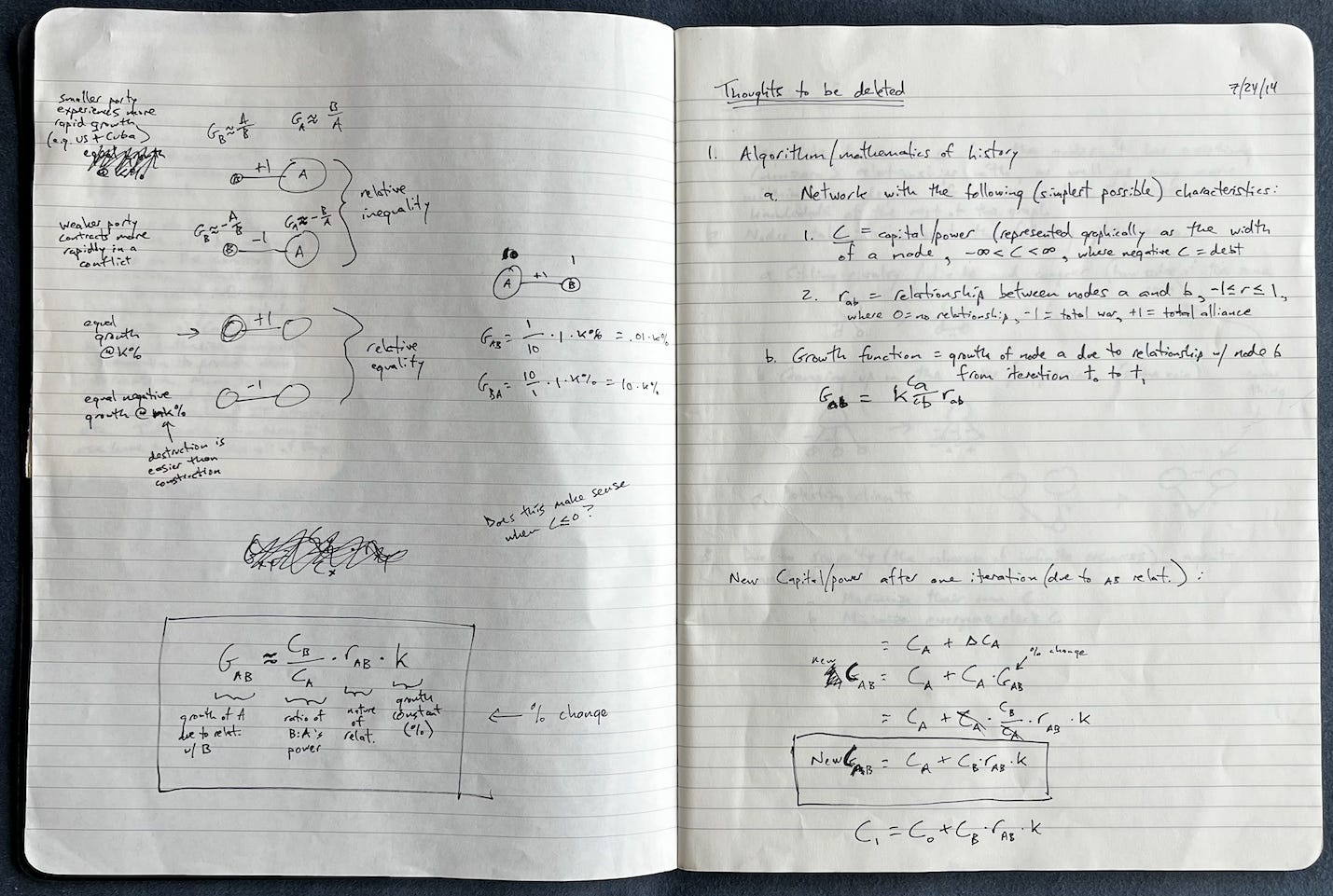
Those thoughts led to other ones, which led to other ones, and so on. Along the way, I wrote a book called Power Structures in International Politics to consolidate what I had figured out. I had hoped that that would be the end of the matter, but the ideas kept coming.
For eleven years. Every single day. On walks by the river. In between meetings. On Amtrak. In the middle of the night. From airplane windows. While people were talking to me. In the quiet pauses of raising two daughters. Through two divorces and six moves. And for well over the proverbial 10,000 hours.
I don’t get paid for this. No one told me to do it. There’s no practical purpose to it. It’s a distraction from every facet of normal life. It sucks energy that I could have used more sensibly as a parent, family member, friend, employee, or neighbor. It results in me having nothing to say about sports, memes, the stock market, or any cultural references since the movie Frozen came out.
What would possess someone to undertake an endeavor like this?
For one thing, political power is a subject of universal relevance, affecting many areas of our lives. It’s a game that has been played for as long as humans have played games. It entails repeating patterns of aggression and cooperation, subjugation and resistance, deception and the force of reason. It’s inherently intriguing.
My daydream in Jamaica seemed like it might unlock a mystery that explains some of those recurring patterns. I sensed that there was a beautiful idea in there, buried deep, and I had a compulsion to explore the uncharted territory, convinced that I was onto something elegant.
Well, maybe I am, or maybe I’m not. In a pursuit like this, you just don’t know. The vast majority of the thoughts that I’ve had in the course of this eleven year “science project” have been dead ends. Failed attempts to tie up a loose thread or reframe a problem or get the computer code right. Those equations in the image above? None of them were the right ones, or even remotely close. Most of those 10,000+ hours were spent doing the wrong thing, chasing some brainstorm that ultimately proved fruitless. All you can do is follow the most promising path forward at any given moment, because you have no idea in advance what’s going to work.
That is, until you suddenly find a solution to the current problem, and then it becomes blindingly obvious. Impossible to see any other way. Like it should have been obvious all along, and like it would be immediately self-evident to anyone else who thought about it. I mean, obvious to the point where you wonder if you even came up with anything noteworthy at all, because even a child could see how simple it is.
In my first year at this, I needed to find a particular mathematical formula. It basically had to say how happy a person would be based on how much power they had relative to other people. I put so much concentration into solving this one problem: hours of focused effort day after day, for ten months, all in my spare time. I encountered failure after failure until all of a sudden one night I combined two conceptual shards and they happened to fit together. The math did everything I needed it to — and then some, because it had a few useful implications that I didn’t grasp until much later. But upon discovering this little gem, I realized that it was very similar to an equation I had encountered in an antitrust class in law school, so it really should have been obvious!
When these eureka moments happen, you savor them, because they don’t last long. You want to share them with people, but they’re often too technically arcane for others to appreciate without excessive explanation. No one cares that you found a new data structure that speeds up a simulation by 3x. And soon enough, maybe the next day, something new to wonder about emerges and it’s back down into the thicket.
In short, this is not a good hobby unless you enjoy being confused most of the time. The breakthroughs are so few and far between that if they were your sole motivation, it would be irrational not to give up. To plod forward, you have to genuinely revel in a sense of bewilderment and accept that you will feel stupid almost continuously.
Curiosity is the only force powerful enough to propel someone to spend their time doing an activity like this. What is political power anyway? What if I try this piece of code? Why is the enemy of my enemy my friend? What if I use colors to represent this variable? Does Aristotle have anything relevant to say here? If this were a board game, how would it work? What would interplanetary politics be like? This kind of incessant questioning has been the engine driving my last eleven years.
And thankfully, the questions are their own purpose, because the vast majority of the time, the answers are not.
All of this struggle and sacrifice, and in the end this project may be a big nothingburger. Maybe it’s based on an erroneous assumption. Maybe it’s not useful. Maybe it’s indeed so obvious that it doesn’t say anything worth saying. Maybe its only legacy will be dozens of notebooks that my kids have to recycle when I die.
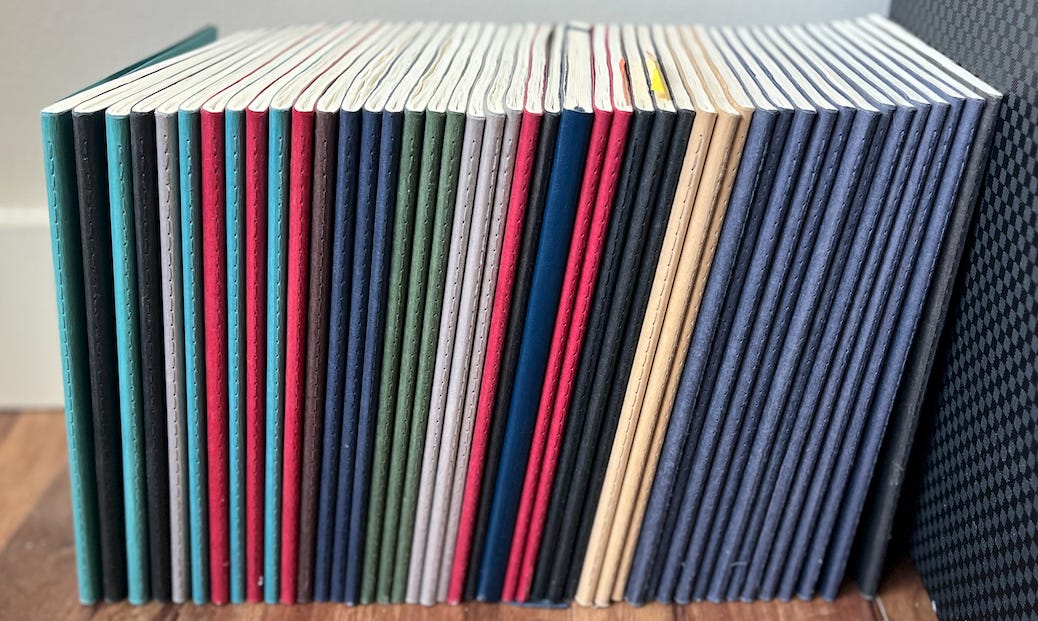
I suppose all of that is out of my control. I don’t know what the ultimate outcome will be. All I know is, it seems like an important idea has presented itself to me, and I feel a sense of responsibility to bring it into the world in as intelligible a form as I can.
Hopefully, it won’t take another eleven years to do that. But it’s impossible to know in advance.